
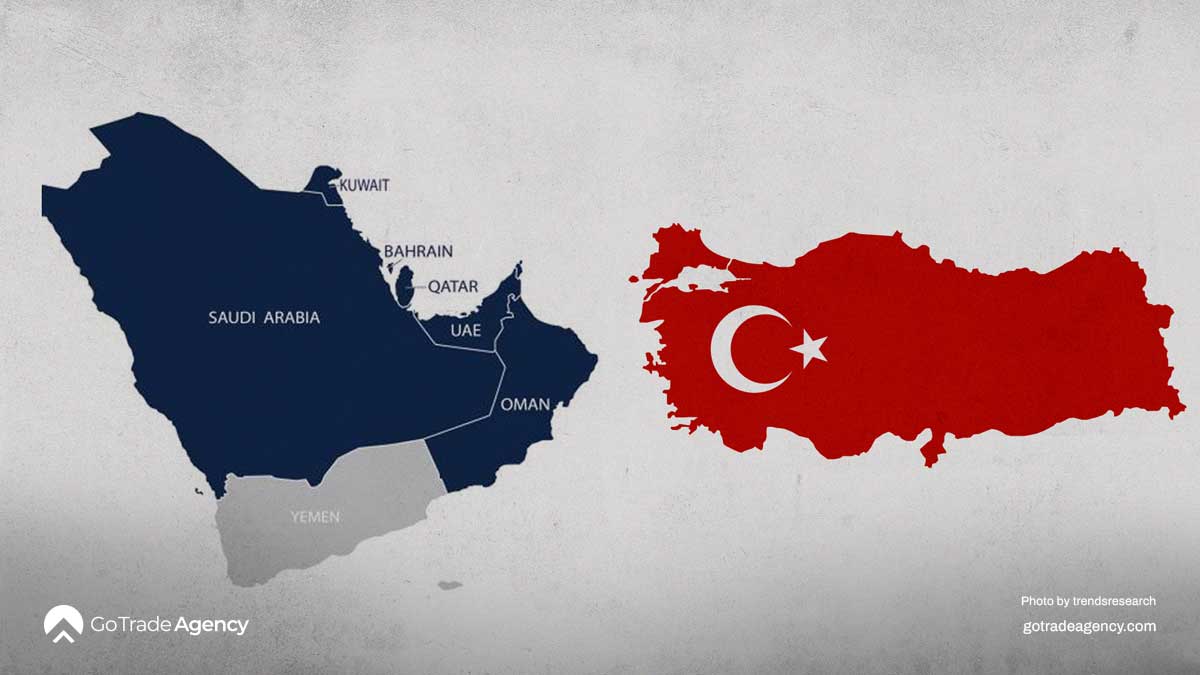
Gulf-Türkiye economic relations are evolving from energy dependencies into diversified partnerships across real estate, defense, logistics, and food security.
In the heart of the Middle East, the Gulf Cooperation Council (GCC) countries; comprising Saudi Arabia, the UAE, Qatar, Kuwait, Bahrain, and Oman; are experiencing a new chapter in their trade dynamics with Türkiye. What once revolved around energy flows and construction contracts has now transformed into a strategic, multifaceted partnership touching nearly every major sector.
With Türkiye’s industrial power and the Gulf’s capital strength, the two regions are working together to build cross-border investment ecosystems. Türkiye exports refined metals, construction materials, defense equipment, furniture, textiles, and food products to the Gulf. In turn, Gulf countries invest heavily in Turkish real estate, logistics hubs, financial services, and high-tech manufacturing zones.
The recent signing of the Comprehensive Economic Partnership Agreement (CEPA) between Türkiye and the UAE marked a significant turning point. The deal eliminates tariffs on thousands of products and is expected to raise bilateral trade to over $40 billion annually by 2030. Similarly, Qatar continues to deepen its financial ties with Türkiye through equity investments and joint ventures in critical sectors like aviation, ports, and banking.
A key area of growth is food security. Gulf nations, reliant on imports due to arid climates, are seeking to secure stable sources of agricultural products. Türkiye’s proximity, fertile lands, and advanced agri-processing capacity make it an ideal partner. Turkish companies are now exporting poultry, dairy, produce, and grains to Gulf markets with increasing frequency.
Defense cooperation is also intensifying. Turkish defense manufacturers have become regular exhibitors at Gulf security expos and have inked deals for drones, armored vehicles, and surveillance systems. As Gulf nations seek to diversify their defense procurement strategies, Türkiye offers competitive pricing and regional reliability.
Moreover, logistics is a cornerstone of the Türkiye-Gulf relationship. With Türkiye acting as a land bridge between Asia and Europe, and Gulf countries anchoring major ports and air freight networks, the combined infrastructure enables smooth and secure transport routes. Projects like the Middle Corridor and Saudi’s Vision 2030 align with Türkiye’s logistic ambitions, creating new lanes of opportunity.
Beyond business, these collaborations are supported by people-to-people ties, rising tourism, and mutual cultural affinity. Istanbul has become a second home for many Gulf investors, while Turkish brands enjoy strong visibility in Gulf malls and media.
Looking ahead, Türkiye and the GCC countries are no longer just trading goods; they are co-architecting the future of regional commerce. This synergy between capital, production, and vision is giving rise to one of the most important economic alliances in the broader Middle East.