
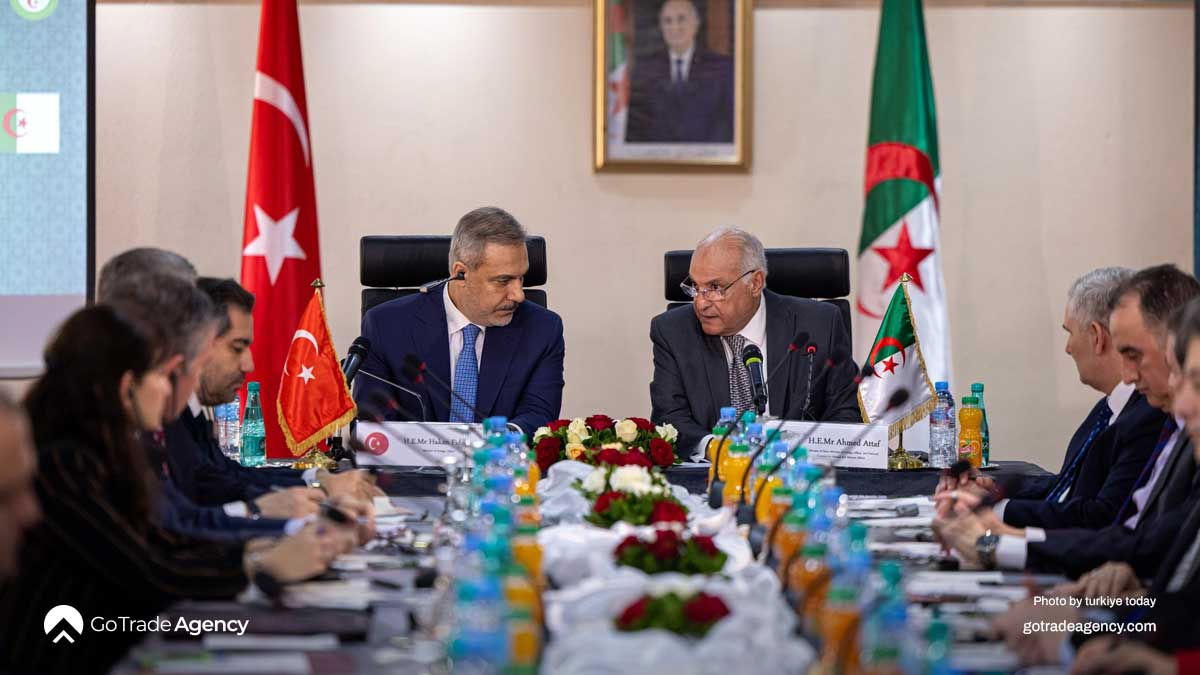
Algeria has set an ambitious goal of increasing its trade volume with Türkiye to $10 billion, as announced by Algerian Foreign Minister Ahmed Attaf following a meeting with Turkish Foreign Minister Hakan Fidan.
For decades, Algeria’s vast resources and geopolitical position remained underleveraged in global trade. But that narrative is changing. Today, Algeria is emerging from the shadows of protectionism and bureaucratic rigidity, unveiling a new chapter that places international commerce, industrial partnerships, and export diversification at the forefront of its economic agenda.
Algeria is the largest country in Africa by landmass and one of the richest in natural resources; particularly oil, natural gas, phosphate, iron ore, and rare minerals. For years, its economic lifeblood was centered almost entirely on hydrocarbons, which accounted for over 95% of export revenues. But this over-reliance made the country vulnerable to global energy shocks and inhibited broader industrial growth.
Recognizing this, the Algerian government launched a wave of economic reforms aimed at reducing its dependency on fossil fuels and attracting foreign investment. The country’s 2020 Finance Law removed the controversial “51/49 rule” that limited foreign ownership in non-strategic sectors; a long-standing barrier that had deterred international companies from entering the Algerian market.
Algeria is now embracing bilateral trade cooperation and infrastructure partnerships, particularly with Türkiye, China, France, Italy, and several Arab countries. In 2023, Algeria signed dozens of agreements with Türkiye and increased its trade volume with the country by over 30%. This includes deals in construction materials, food processing, textiles, and renewable energy.
Moreover, Algeria is a pivotal player in the African Continental Free Trade Area (AfCFTA); a pan-African initiative that aims to create the world’s largest free trade zone. This integration opens up north-south trade corridors for Algerian companies, especially in exporting industrial and agri-based goods to Sub-Saharan Africa.
Domestically, Algeria is improving its port infrastructure, upgrading rail and road links, and digitizing its customs systems. The Port of Algiers, Oran, and the future Port of El Hamdania are envisioned as major logistical gateways for Europe-Africa-MENA trade flows. These modern trade corridors are expected to rival regional hubs and support large-scale manufacturing and distribution.
Algeria’s strategic alliance with China via the Belt and Road Initiative has also fueled the development of industrial parks and power projects that support export-driven growth. Its natural gas deals with Italy and efforts to become an energy bridge to Europe further amplify its trade value.
At Go Trade Agency, we view Algeria as a market of transition and a high-potential partner for international businesses. We are currently building partnerships to support companies interested in sourcing Algerian raw materials, exploring joint ventures, and opening distribution channels into the Maghreb.
As reforms gain momentum and logistics modernize, Algeria is moving from isolation to interaction; positioning itself not just as a producer, but as a regional trade leader and continental logistics hub for the Arab and African worlds.