
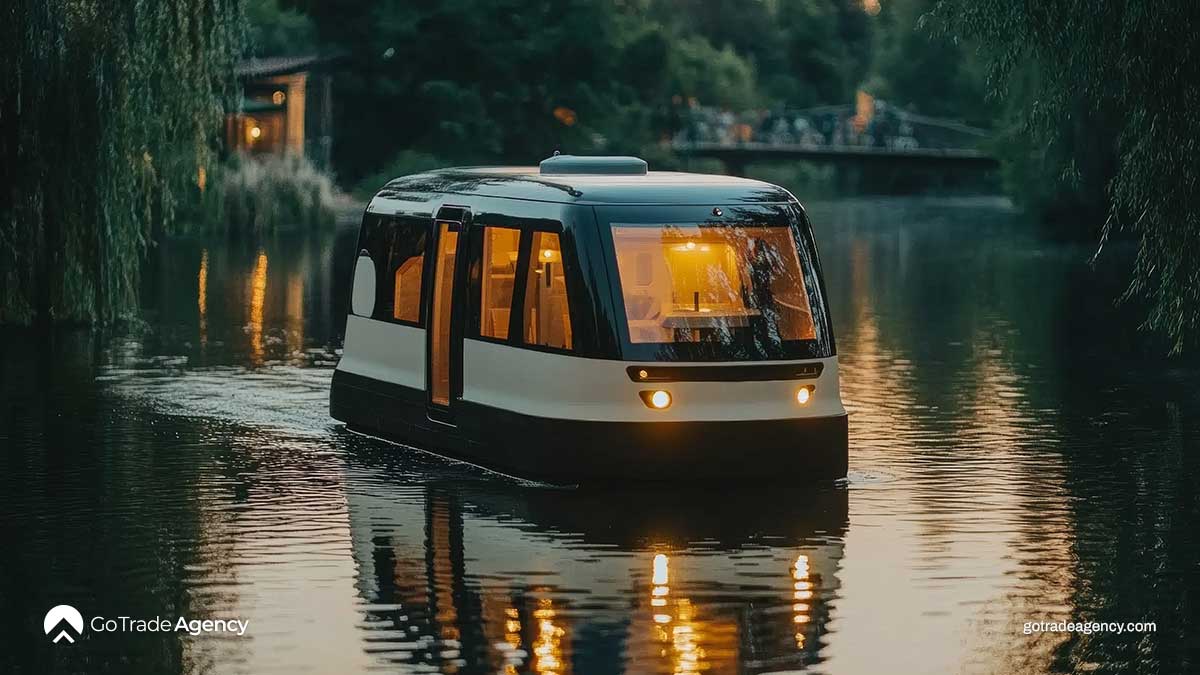
The concept of the “floating caravan” a hybrid between a traditional camper and a watercraft is rapidly capturing interest beyond national borders. These dual-purpose vehicles, capable of navigating both land and water, offer a unique blend of freedom and functionality for travelers seeking more than just a conventional road trip.
Able to serve as a caravan on rugged terrain or transform into a compact yacht on inland waters, these innovative vehicles represent a new era in adventure travel. Their design typically includes options for both gasoline and electric engines and allows for steering either from a traditional boat rudder or a front-mounted engine, depending on the user’s preference.
Floating caravans have been exhibited at major travel and lifestyle expos alongside other outdoor innovations such as tiny houses, prefab homes, and eco-tourism equipment. Their appeal lies not only in novelty but in the promise of flexible, off-grid living. They’re built with essential amenities like a stove, sink, indoor and outdoor showers, a toilet, heater, solar panel system, and even a sound system all packed within compact floor plans ranging from 8 to 9.5 square meters.
One notable development in this field has come from Türkiye, where a floating caravan project initiated in 2020 in Amasya’s Merzifon district helped propel the concept into reality. Turkish innovators were among the first in the region to envision a fully amphibious travel trailer, blending local craftsmanship with global engineering standards. After years of R&D and international testing, Türkiye began exporting these versatile units abroad, particularly to countries like Germany, Canada, and the United States showcasing the nation’s growing role in shaping sustainable, multi-environment tourism solutions.
The interior is designed to prioritize both safety and comfort. Safety systems often include fire suppression, bilge pumps to remove water intrusion, and structural reinforcements such as double polyurethane-insulated hulls to prevent sinking even after impact. Whether for lakeside camping, coastal exploration, or simply escaping urban congestion, floating caravans support a lifestyle centered around movement, nature, and self-sufficiency.
Though the concept is still developing globally, interest has surged in recent years, with several producers now scaling up manufacturing to meet international demand. While global competitors price such amphibious vehicles at a premium, more affordable models are beginning to emerge in various regions offering buyers durable, lightweight options built to European standards.
Floating caravans are more than just a quirky travel option they are a symbol of evolving consumer preferences: mobile living, independence, and reconnection with natural environments. As production expands and awareness grows, this hybrid vehicle is poised to redefine how we experience the journey not just the destination.